Valitive is a platform that connects event producers, project managers, and audio-visual firms with freelancing professionals in the industry. The proven business model of Valitive has a higher demand, and the platform they used to operate on was essentially at capacity ( The company has a WordPress website with very few operational engagements, and many business operations were performed manually ). Recognizing this growth barrier, they decided to go for a fully automated web-based solution to manage the organization's functions. This is where Fidenz came into the picture and assisted the Valitive by engineering a fully customized web solution with a robust framework that allows integration, automation, and scalability.
*logo/name integrity claim
Client Requirement
Valitive organization has been managing their service's operations via manual approaches, and the requirement was to develop a more efficient, scalable web application using the most relevant technologies to upscale their service to the next level. The ultimate goal was to stand out from other competitors in their domain and connect event producers/managers with the best audio/visual freelance contractors available in the industry, using a "gig" based engagement model.
Simplifying the registration process, automating the documentation works, creating a digital call sheet with calendar integration, providing a user dashboard to manage the profiles, freelance gigs, event calendars, call sheets, and creating a custom CMS/portal was among the main requirements of this system, which eventually summed up to a good amount of work.
Challenges in the Business model
The business domain that Valitives are engaged in is quite a competitive and challenging one. With the established competitors alongside them, the need of engineering a competent system was required. Perfection was much highlighted here due to these factors. A top-notch user experience and efficient collaborative operations were also expected.
Also, the nature of their business model itself was very dynamic. Understanding their domain, finalizing and mapping all of its current and potential requirements into the platform while expecting changes and more future accommodations, was indispensable and very much challenging.
Challenges in Technology
While selecting the stack of technologies to complete the project, serious attention was paid to the end-user experience, smooth functioning of internal mechanisms, and overall well-being. Rapid development, continuous integrations, ceaseless delivery, maintainability and scalability of the system, and performance were among our major concerns while planning this project. The dynamic nature of the business model and the complexity of the requirements made it tricky to sustain all the qualities at once. Hence, it was a critical decision to make the best choices in selecting tools and to come up with an excellent software product.
Apart from that, with the already long-established manual process and members accustomed to old procedures, Valitive expected the same undertaking in the new platform too. Hence, it came to a conclusion that the core mechanism was not flexible for adaptations. Above all, it was crucial to keep the platform with a minimum maintenance downtime and be available to access at any given time of the day. Optimal reliability was another vital condition since the entire business operations of the organization were handled by it.
The confidential businesses and personal data handling through the system made security a critical factor. However, the world-class expertise of the Fidenz engineering team knew how to overcome these challenges by building systems of this scale.
Solution
Despite all the aforementioned complexities, the Fidenz team came up with a robust system that consisted of all the desired features and deployed it in AWS cloud hosting by July 2019. A dedicated CI/CD pipeline was also created for deployment purposes. We further integrated automated regular backing up features, improving its recoverability, and secured the platform and all its communications with SSL, delivering an excellent product exceeding the client's expectations.
With our recommendation, the client gave us the consent to go ahead with a set of Royalty-free technologies (opensource) to accomplish everything. This brought down the final cost of the project by a significant portion. Most importantly, it enabled us to gain more flexibility and maintainability with incredible customizability, resulting in an outstanding overall performance.
Size of the Platform
- 70M+ business data points
- 20+ microservices
- 10K unit tests
- 10+ Kubernetes clusters
- 15+ server instances across two AWS regions
Technologies and Tools
| Layer | What runs it |
|---|---|
| Version controlling | Self-managed GitLab |
| Continuous deployment | TeamCity, Azure DevOps Pipeline |
| Containerization | Docker, Amazon Elastic Container Registry (ECR) |
| Container management | Amazon Elastic Container Service (ECS), Amazon Elastic Kubernetes Service (EKS) |
| Domain management and routing | Route53 |
| Load balancers | Amazon Elastic Load Balancer (ELB), NGINX Ingress Controller |
| HTTP cache | Nginx |
| Log management | Elasticsearch, Logstash, Kibana |
| Data processing | Kafka, Elasticsearch |
CI/CD for the Microservices
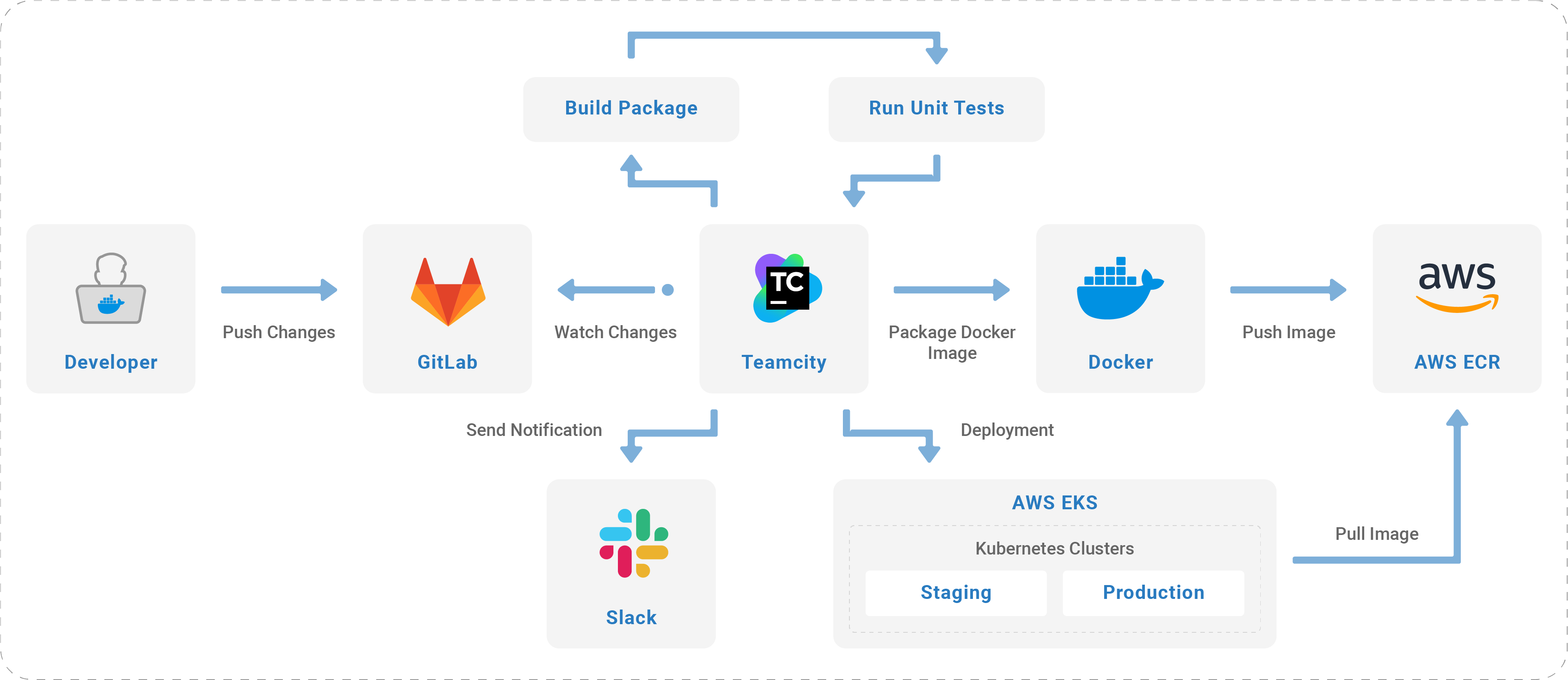
Every application repository is managed on GitLab under a clean Git Flow pattern, with TeamCity and AWS CodePipeline driving the automation. The pipeline builds each Spring Boot service, checks it and runs its automated tests; a successful build is packaged as a Docker image and registered in ECR as a new version. New containers then roll into ECS with no downtime on the live system.
Automated Data Cleansing
The cleansing process pulls updated data from several sources and makes it available in a structured, B2B-exchangeable format, which means merging and verifying records rather than simply copying them across.
Beyond the DevOps Role
Our DevOps team went past the brief and designed that cleansing process end to end. It connects a handful of data sources holding on the order of 120 million records, using Apache Kafka, with different brokers handling different data types and producing into MySQL, an Elastic index and static data files. The Kafka setup runs on a Kubernetes cluster and processes on a scheduler.